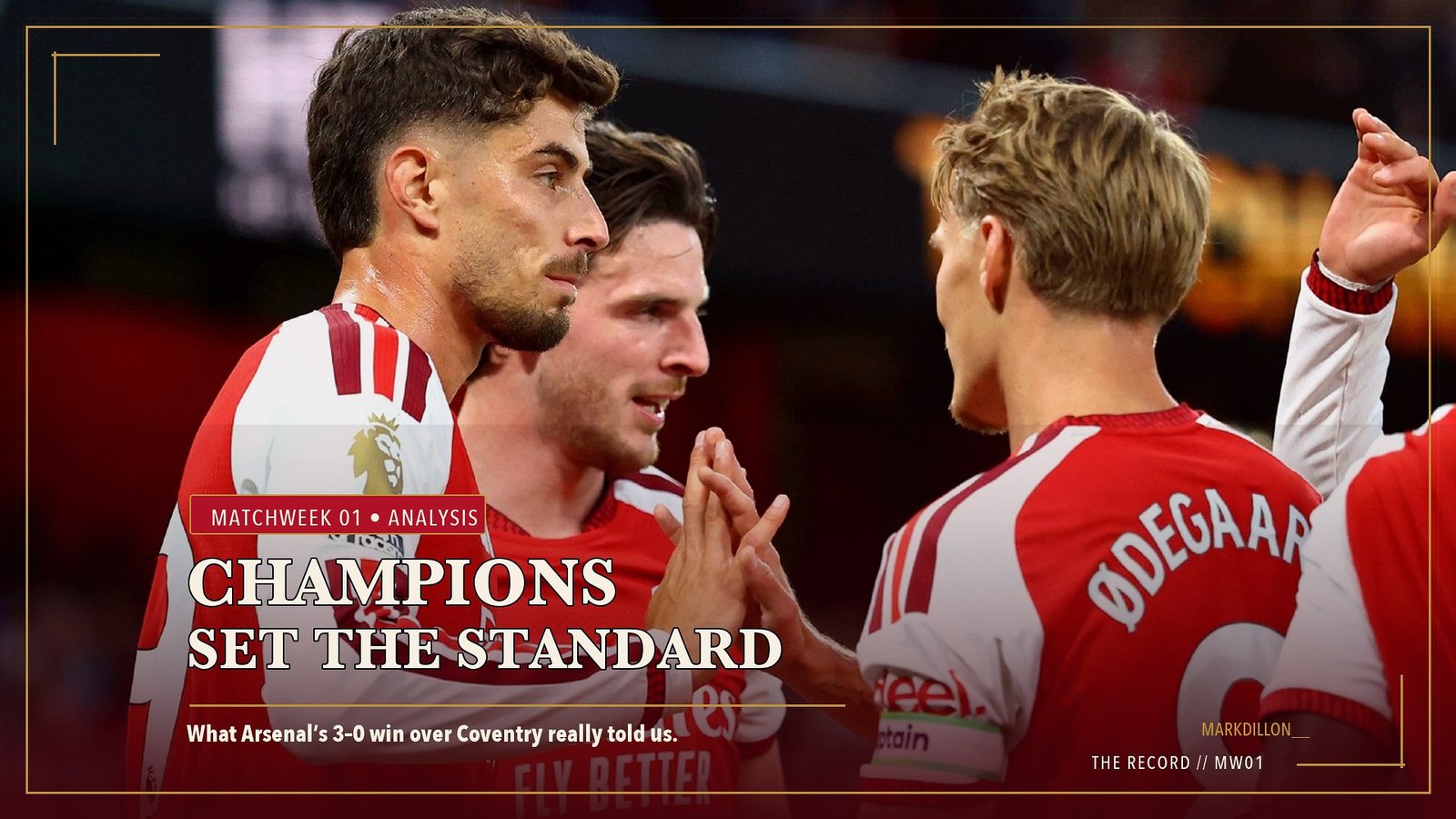


There are opening-day victories that provide three points and little more. Arsenal’s 3–0 win over Coventry City offered something richer: evidence that the champions have returned with their core mechanisms intact, new solutions beginning to form and a squad capable of controlling both the contest and its physical demands.
This was not a frantic statement built on emotion. It was a measured one. Arsenal established territorial control, scored twice inside 23 minutes, added a third shortly after half-time and then managed the remainder without allowing Coventry a route back into the match.
The numbers describe the imbalance. Arsenal had 64.1 per cent possession, completed 565 passes at 91.7 per cent accuracy and produced 20 shots to Coventry’s four. The expected-goals figures were 1.88 to 0.20, while Arsenal recorded 36 touches in the opposition box compared with only three for the visitors. Coventry managed a single shot on target. Sky Sports’ match statistics
Yet the most important detail was not simply that Arsenal dominated. It was how naturally the pieces connected.
Tzolis gave Arsenal more than width
Christos Tzolis’ Premier League debut was the performance that changed the texture of Arsenal’s attack.
Starting from the left, the Greek international was direct without becoming predictable. He could hold the width, drive inside, press the full-back or release the ball early. His aggression helped create the turnover preceding Havertz’s opener, and his low delivery forced Carl Rushworth into the parry from which Saka scored the second.
That involvement in both first-half goals captures his value. Tzolis did not need the game to be constructed entirely for him; he accelerated moves that were already developing. When Declan Rice carried the ball through the centre for the second goal, Tzolis recognised the space immediately, stayed available on the outside and delivered before Coventry could reset.
His arrival also created a better balance across Arsenal’s front line. Saka remains the primary one-against-one threat on the right, but Coventry could not simply tilt their defensive attention towards him. Tzolis offered genuine danger on the opposite flank and repeatedly forced the visitors to defend the full width of the pitch.
Arteta praised the team’s “domination, clarity, understanding and flow,” while Ødegaard described Tzolis as lively, intelligent and difficult to defend. The captain’s most telling observation was that the winger regularly looks up and finds the correct pass. That is precisely what made the debut impressive: the threat came with judgment. Reuters’ match report and post-match reaction
Comparisons with Alexis Sánchez have already surfaced, but they are premature. The useful conclusion is simpler. Arsenal appear to have added a left-sided attacker whose first instinct is to disturb the defence—and whose decisions can complement, rather than interrupt, the collective structure.
Havertz restored the centre of the attack
Kai Havertz’s opening goal was an example of economy. Tzolis’ pressure unsettled Coventry, Riccardo Calafiori reacted decisively and Havertz guided the resulting pass into the bottom corner with his first touch.
It was not a spectacular finish, but it was the kind Arsenal need from their central forward: early movement, composure and punishment when the opposition’s shape breaks.
Havertz also helped connect Arsenal’s midfield runners and wide players. His positioning occupied Coventry’s centre-backs, creating room around the edge of the area, while his ability to drift and combine prevented the attack from becoming fixed. With Saka and Ødegaard both starting alongside him, Arsenal reunited three of their most important attackers—a combination that was rarely available in the league last season.
That context matters. Not every attacking improvement requires a completely new system. Availability itself can be transformative. Arsenal looked fluent partly because familiar relationships were restored around a new threat on the left.
The right-side triangle returned
The third goal provided the clearest reminder of an established Arsenal pattern.
Ben White advanced around Saka, received the ball on the overlap and cut it back for Ødegaard. The captain did not strike it cleanly, but the finish wrong-footed Rushworth and ended the contest four minutes into the second half.
The imperfect execution should not obscure the quality of the mechanism. White’s overlapping run stretched Coventry’s left side, Saka’s presence attracted attention and Ødegaard arrived in the central space created behind them. At its best, the White–Ødegaard–Saka triangle gives Arsenal rotation, width and an extra runner without isolating any of its three parts.
This relationship was once one of Arsenal’s most reliable attacking routes. Seeing it produce again on the opening night suggests that the champions are not rebuilding from zero. They are restoring proven combinations while adding new ones elsewhere.
Ødegaard’s influence extended beyond the goal. He controlled the tempo, contributed to the transition that produced Saka’s finish and consistently connected midfield with the front line. The Guardian named him player of the match, while the broader performance reinforced why Arsenal’s captain remains central to the team’s attacking rhythm. The Guardian’s live match report
Lewis-Skelly strengthened the midfield platform
Myles Lewis-Skelly’s work in midfield was less dramatic but highly significant. His ability to receive and turn under pressure helped Arsenal move through Coventry rather than merely circulate around them. He was secure enough to preserve control and adventurous enough to threaten the next line.
Alongside Rice, he gave the team a platform from which both full-backs could become involved. Calafiori stepped forward to assist the first goal, while White supplied the third. That contribution from both sides of the defence reflects a team whose possession structure was functioning as intended.
There were minor imperfections. Coventry’s Loum Tchaouna almost surprised David Raya with an overhead attempt before half-time, and Jack Rudoni was left free for a late header that went directly at the goalkeeper. Cristhian Mosquera and Gabriel were not always perfectly coordinated when Coventry attacked the box, and Arsenal were caught offside five times.
Those moments did not alter the match, but they are useful warnings before the trip to Aston Villa. Better opponents will punish loose marking and poorly timed runs more severely.
Control after the third goal was a strength, not a disappointment
Once Ødegaard made it 3–0, Arsenal’s urgency dropped. That could be read as a failure to chase a larger score; in reality, it was sensible game management.
Arteta was able to remove Rice and Saka after 67 minutes, withdraw Ødegaard and Tzolis shortly afterwards, and give minutes to Martín Zubimendi, Noni Madueke, Eberechi Eze, Mikel Merino and Piero Hincapié. The quality of those substitutions illustrated the depth now available. Viktor Gyökeres, Ethan Nwaneri and Max Dowman remained unused, with other senior players unavailable.
For a team expected to compete on several fronts, winning comfortably while reducing the workload of key players is valuable. Arsenal did not lose control when the game changed shape; they simply changed its objective—from creating separation to protecting it.
Coventry’s lesson—and the proper limit of Arsenal’s conclusions
Coventry’s return to the Premier League after 25 years could scarcely have begun with a harder assignment: away to the defending champions in a charged Emirates Stadium.
Frank Lampard said Arsenal “played like champions” and described the match as an important lesson in the level required. He also insisted this result would not define Coventry’s season. That is fair. The visitors’ four shots, three box touches and 0.20 xG exposed the gap on the night, but survival will be decided far more by matches against direct rivals than by an opening trip to Arsenal. Lampard’s post-match reaction
The same caution applies in reverse. Arsenal should have beaten a newly promoted side at home. One controlled victory does not prove that a title will be retained, especially when the next match at Aston Villa promises a much more severe examination.
What it does provide is a strong baseline.
The real message of the night
Arsenal’s title defence began with the feeling of continuity rather than burden. Arteta suggested that being champions allowed his players to relax and “flow” on the pitch. The performance supported that idea: there was authority in possession, patience without passivity and a collective understanding of where the next action should come from. Arteta’s official post-match press conference
Tzolis gave the left side fresh energy. Havertz supplied a focal point and an early goal. Saka remained decisive. Ødegaard dictated the game and scored. White’s overlap reactivated a familiar weapon. Lewis-Skelly helped hold the centre. The bench allowed Arsenal to close the match without overextending their most important players.
That is why the victory was more meaningful than a routine 3–0 scoreline suggests. Arsenal did not merely look stronger than Coventry. They looked like a team that understands itself—and one that may now possess more ways to express that identity.
The champions have not answered every question after one match. They have, however, set the standard from the first night.
Sources and further reading
- Arsenal official match report
- Mikel Arteta’s full post-match press conference
- Arsenal official highlights
- Reuters match report and interviews
- Premier League match centre
- Sky Sports match statistics
- The Guardian live report and post-match analysis
- The Short Fuse tactical observations
- Frank Lampard’s post-match reaction