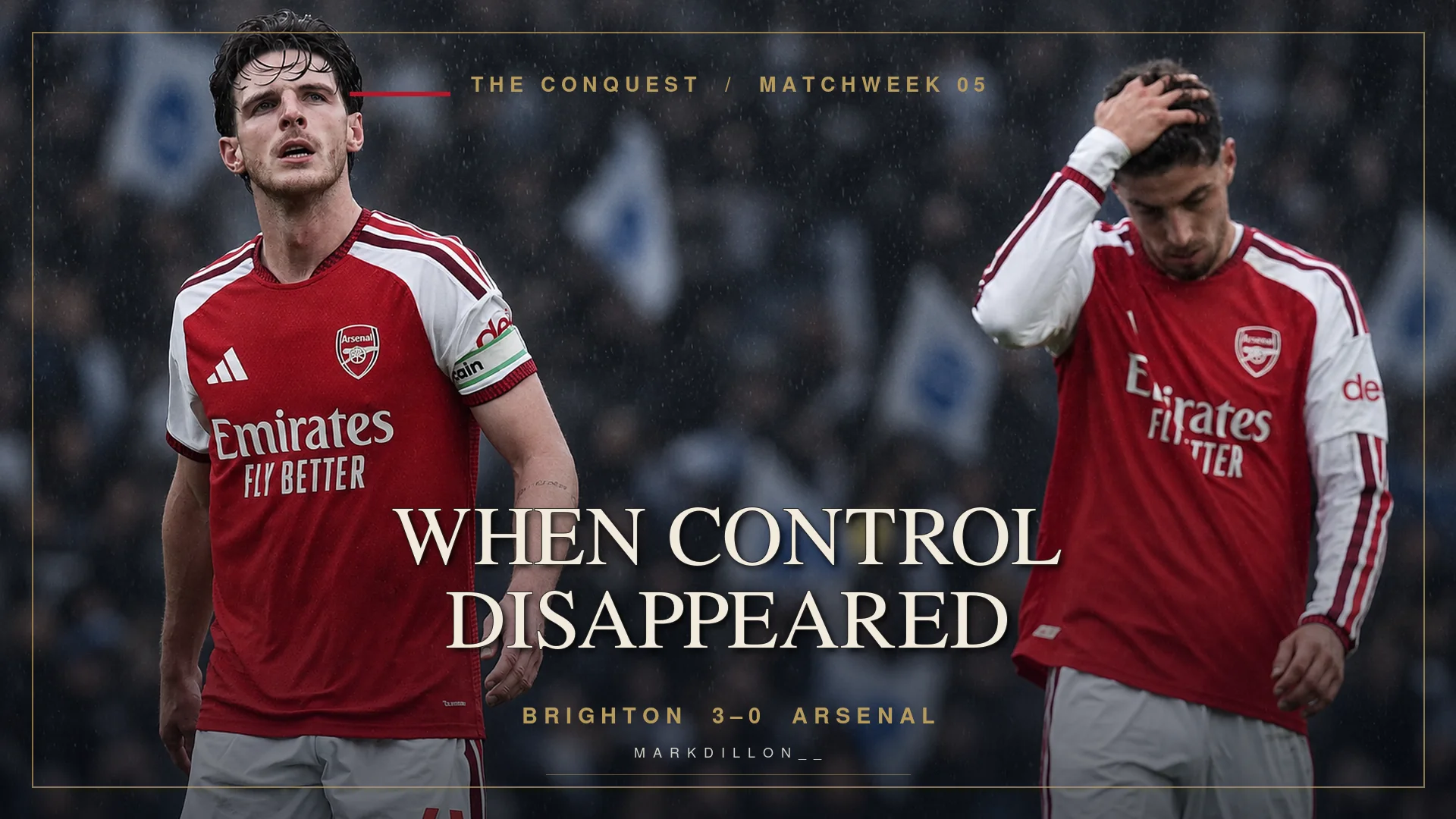


Match details
- Competition: Premier League, Matchweek 5
- Date: 19 September 2026
- Venue: Amex Stadium
- Result: Brighton & Hove Albion 3–0 Arsenal
- Goals: Pascal Groß 31', Charalampos Kostoulas 45', Chema Andrés 57'
- Half-time: Brighton 2–0 Arsenal
Key data
| Metric | Brighton | Arsenal |
|---|---|---|
| Possession | 40% | 60% |
| Expected goals (xG) | 1.30 | 1.57 |
| Shots | 17 | 11 |
| Shots on target | 5 | 2 |
| Big chances | 4 | 2 |
| Corners | 5 | 6 |
Data: 365Scores/FotMob. Models can vary slightly by provider.
When Control Disappeared: What Arsenal’s 3–0 Defeat at Brighton Exposed
The most revealing number at the Amex was not three. It was 60.
Arsenal had 60 per cent of the possession, yet rarely possessed the match. Brighton decided where it would be played, how uncomfortable it would feel and which team would reach the important actions first. By the time Chema Andrés headed in the third goal after 57 minutes, the champions’ perfect Premier League start had not merely ended; their familiar authority had disappeared.
That distinction matters because the data creates an apparent contradiction. Arsenal finished with a marginal expected-goals advantage, approximately 1.57 to 1.30, and took six corners to Brighton’s five. Those figures could support a story about ruthless finishing at one end and wasted chances at the other. There is some truth in that. Bukayo Saka and Christos Tzolis had opportunities capable of changing the match.
But the evidence of the contest—the 17–11 shot count, Brighton’s four big chances, Arsenal’s two efforts on target and the repeated errors forced close to David Raya’s goal—supports a broader conclusion. Brighton were the more coherent and forceful team. The 3–0 margin exceeded the xG difference, but the victory did not.
Brighton won the match before playing through it
Fabian Hürzeler’s post-match explanation was almost a tactical manifesto disguised as psychology. Brighton targeted “small wins”: the first throw-in, first header, first tackle and first corner. Each was treated as a way to build emotional and territorial momentum. Arsenal knew this pressure was coming and still failed to absorb it.
Mikel Arteta said the warning was visible from the first throw-in. His strongest criticism was that Arsenal were “another gear” below Brighton in the basics: first duels, second actions and loose balls. That is not simply a demand for greater effort. In a man-oriented press, winning the first contact changes the entire geometry of the next phase. The press’s aggressor can squeeze forward; the team under pressure loses its spacing and begins receiving passes while facing its own goal.
Brighton’s front line, led energetically by 19-year-old Charalampos Kostoulas, repeatedly made Arsenal’s first pass feel like an emergency. Bruno Guimarães’ misplaced ball created an early shooting opportunity that Raya had to divert. Raya later surrendered possession to Yasin Ayari in another dangerous area. These were technical mistakes, but they were not isolated accidents. They arrived inside a structure Brighton had designed to hurry decisions and punish hesitation.
Arteta described Arsenal as failing to “respect the game” and the principles required against a man-to-man press. The phrase should not be read as arrogance. It referred to risk recognition: knowing when a short combination is available, when the receiver is trapped, and when a longer pass is necessary to move the contest away from danger. Arsenal kept attempting to establish their preferred rhythm without first earning the security to do so.
Possession without protection
The first goal illustrated a second problem. Kostoulas found Groß near the edge of Arsenal’s box, where the veteran was allowed enough time to guide a precise strike in off the post. Arsenal’s concern with Ayari’s position contributed to the hesitation, but neither Gabriel nor Riccardo Calafiori closed the shooter decisively.
This is where build-up and defending become the same conversation. Poor possession does not end when the ball is lost. It leaves defenders reacting from compromised distances, midfielders behind the next action and opponents attacking before Arsenal’s rest defence is organised. Brighton’s pressure therefore produced more than turnovers: it repeatedly removed the protective structure Arsenal normally carry behind the ball.
The second goal, struck by Kostoulas from distance on the stroke of half-time, was another fine finish and another sequence Arsenal will dislike. Gabriel was slow to recognise the danger, while the collective response lacked the urgency Brighton had shown from the opening minute. Arsenal had just passed up an equalising chance through Saka. Instead of reaching half-time level, they arrived there two goals down.
Andrés’ far-post header from Groß’s corner after the break completed the tactical indictment. Arsenal had conceded only once across their opening four league games, but their normally dependable set-piece defence failed at the moment a response was required. The scorer was able to attack an excellent delivery with insufficient disruption. Reuters noted that Arsenal could have lost by more, and Brighton struck the woodwork late as the match stretched.
The chances Arsenal will regret
None of this means Arsenal were without routes back into the contest. Saka released Tzolis on a promising break before the opening goal, but the opportunity was not converted. Martin Ødegaard then created a major chance for Saka shortly before Brighton made it 2–0. Those moments help explain Arsenal’s relatively healthy xG figure.
They also underline the difference between creating chances and controlling their context. Arsenal’s opportunities were potentially transformative but sporadic. Brighton’s threat was persistent, supported by a press that kept generating field position and belief. When Arsenal missed, Brighton’s structure survived. When Brighton attacked Arsenal’s errors, the visitors’ structure was often already broken.
The attacking selection will invite questions. Kai Havertz offered familiar connecting movement, but Arsenal struggled to establish possession high enough for it to matter consistently. Tzolis found one transition opening without imposing himself thereafter, while Saka’s missed opportunity became more costly seconds later. The introduction of Viktor Gyökeres, Mikel Merino and eventually Max Dowman could not reverse a match whose emotional direction was already fixed.
It would be simplistic to argue that one different starter solves this. Arsenal’s failure began behind the forwards: unstable progression, slow reactions to turnovers and an inability to win the second ball that would have sustained pressure. Personnel can alter the routes, but the collective execution was the primary fault.
A psychological defeat as much as a tactical one
Brighton’s “small wins” language explains why the afternoon felt more emphatic than the xG difference. Their players and crowd fed one another. Every recovered ball strengthened the press; every Arsenal error made the next receiver less secure. The Amex anniversary atmosphere became a competitive weapon.
Arsenal moved in the opposite direction. Early mistakes produced anxiety rather than simplification. The second goal landed immediately after a missed chance, the third killed the initial second-half reset, and frustration eventually surfaced in Declan Rice’s late clash with Malick Yalcouyé. VAR did not judge the incident worthy of a red card, but the petulance was another sign of a team that had lost emotional control as well as the match.
This is interpretation, not proof of a lasting mentality problem. The stronger evidence points the other way: Arsenal entered the fixture with seven wins in all competitions and four league victories, and had conceded only one league goal. Arteta was right to place the defeat against that larger body of work. One performance does not invalidate the resilience shown at Sunderland or the patience displayed in Naples.
Yet champions are studied more closely and pressed with greater conviction. Brighton demonstrated that if Arsenal’s build-up becomes casual and their response to contact passive, the control on which their football depends can unravel quickly.
The balanced verdict
The concern is not that Arsenal lost an away match to an excellent Brighton side. Hürzeler’s team reached 16 league goals in five games—six more than any other side at the final whistle—and executed an ambitious plan with courage. The concern is how many of Arsenal’s safeguards failed together: technical security, duel intensity, second-ball coverage, box defending and set-piece concentration.
There are positives, though modest ones. Arsenal still created two big chances on a poor day. Ødegaard found the pass for Saka’s best opportunity. The squad had enough quality on the bench to change the attacking profile. Most importantly, the failure was obvious rather than mysterious. Arteta does not need to invent a new identity; he needs to restore the standards that allow the existing one to function.
Supporter reaction understandably carried anger and embarrassment. Arsenal-focused ratings and fan channels converged on the view that the team was collectively below standard, while some supporters also placed the result in the context of an exceptional recent run. Both responses are reasonable. A title-defending side should not normalise being second to every decisive action, but neither should one afternoon become a referendum on the entire project.
The useful lesson is sharper. Possession is not control when the opposition dictates the risks. Tactical principles are not a comfort blanket; they demand precise execution and the humility to adapt when the first route is blocked. Brighton understood the game’s temperature immediately and grew through every small victory. Arsenal recognised it too late.
After an opening month defined by answers, the champions finally met a problem they could not solve. What matters now is whether this 3–0 defeat becomes an isolated warning—or a map opponents can reuse.
Editorial source notes
- Arsenal official match report — result, scoring sequence and Arsenal match narrative.
- Reuters: Arteta vows Arsenal will learn from chastening defeat — Arteta reaction, Andrés interview, league context and assessment of Brighton’s press.
- Sky Sports match report — match chronology, goals and overall performance assessment.
- Sky Sports: Arteta on failing to respect the game — extended Arteta post-match comments on duels, technical errors and build-up principles.
- The Guardian match report — on-site chronology, pressing detail, player observations and anniversary atmosphere.
- The Guardian: Arteta and Hürzeler reaction — both managers’ post-match explanations and Hürzeler’s “small wins” concept.
- Arseblog News supporter ratings — Arsenal supporter mood and fan-voted performance context.
- Statistical figures were cross-checked against 365Scores and FotMob. xG models vary; the numbers are used directionally, not as definitive measures of performance.
- No standalone verified Arsenal player interview was publicly indexed at publication time. Chema Andrés’ remarks are included through Reuters; no unverified player quotes have been added.